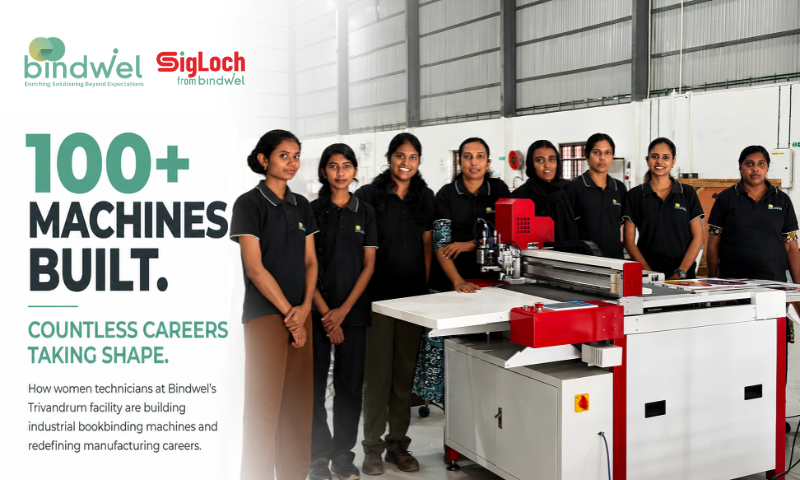
That number stopped us too, the first time we said it out loud.
This is the story we shared at PrintWeek’s Women to Watch Awards 2026 in Mumbai on 9 June. And this is the longer version – because 100 machines deserve more than a slide.
🏭 The Team That Proved the Point
Women engineers in manufacturing are not a new idea. They are an underused one.
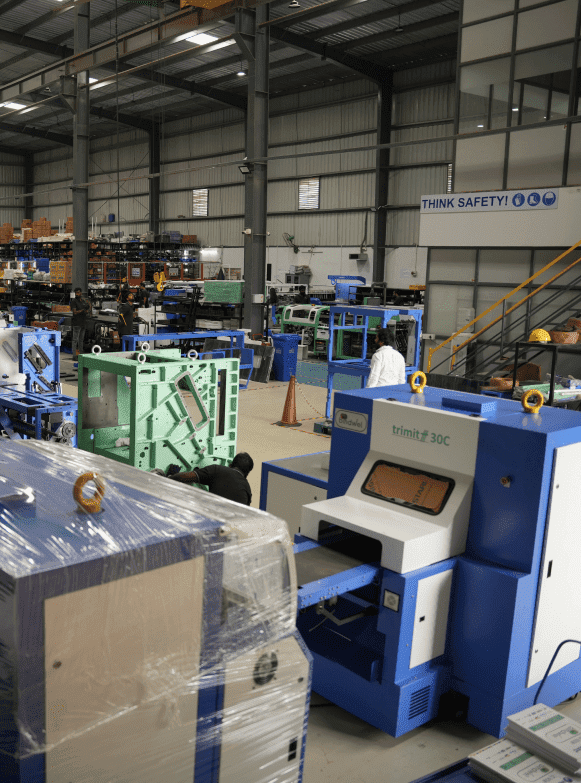
At Bindwel’s primary manufacturing plant in Trivandrum, an initial team of 8 women technicians has collectively assembled over 100 industrial bookbinding machines, including machines from our SigLoch post-press range.
These are not simple assemblies. Bookbinding machines involve mechanical sub-systems, pneumatic components, precision tolerances, and careful quality checks at every stage. These women built them. All of them.
When we saw that number cross 100, we knew we were not experimenting anymore. We were building something real.
🎓 Where Women Engineers in Manufacturing Come From
Women engineers in manufacturing do not arrive fully formed. Someone has to go and find them.
We went to Industrial Training Institutes and polytechnic colleges in Trivandrum. Specifically, we targeted institutions in interior areas, where students come from financially challenged families – children of daily wage workers, farmers, people for whom getting a technical education already takes everything they have.
We ran direct recruitment panels. We explained what Bindwel does, what the work looks like, what the career path looks like. And then we listened.
They showed up. More than we expected.
🔧 The 6-Month Training Program: What We Actually Teach
Selected candidates enter a six-month structured training curriculum at our Trivandrum factory. The program covers:
- Mechanical machine assembly – building bookbinding and post-press equipment component by component
- Pneumatic engineering fundamentals – understanding and working with the air-pressure systems in our machines
- Quality assurance and inspection – measuring, checking, and certifying finished output to production standards
- Travel readiness and safety skills – practical preparation for field deployment anywhere in India
That last point is not standard on any engineering curriculum we have seen. But it is one of the most important things we teach.
Top performers from each training batch are elevated to field service engineer roles. That means traveling to customer sites across India – sometimes on short notice – to install, service, and troubleshoot machines.
For a young woman from a small town in Trivandrum who has never booked a flight or stayed in a hotel alone, that is a significant ask. We treat it like one.
👩🔧 The Story That Changed How We Think About Women Engineers in Manufacturing
Sruti Sajith, our lead of growth and strategic projects, shared a specific story at PrintWeek’s Women to Watch Awards that stayed with the room.
One of our women engineers received a call to travel to Hyderabad on short notice to resolve a machine breakdown at a customer facility. She was technically ready. But travel safety concerns were real enough that she chose to travel accompanied by her mother.
She went. She fixed the machine. The customer was happy.
But it made us think hard about what women engineers in manufacturing actually face beyond the factory floor. Travel safety. Family anxiety. Social conditioning that nobody audits or measures. These are not excuses. They are real, practical barriers that most companies simply do not address.
So we built parent engagement directly into our program. We work with families, address concerns, and build the domestic confidence that makes a long-term manufacturing career possible – not just a six-month stint.
Because retention was always the goal, not just recruitment.
🏫 Planting the Seed Earlier: Factory Visits for School Students
One thing we learned quickly: the pipeline problem starts before ITI.
Many young women do not enroll in technical programs in the first place because they have never seen a woman working in a factory. It is not a lack of interest. It is a lack of visibility.
We started organizing factory exposure visits for students from government schools in the areas surrounding our Trivandrum plant – specifically for students in Grades 9 and 10. Both girls and boys.
They walk the factory floor. They see women managing heavy machine tools, assembling equipment, running quality checks. They ask questions. A lot of questions.
For many of them, it is the first time manufacturing has felt like something they could actually do.
📈 Why Women Engineers in Manufacturing Are Good for Business
We want to be direct about something.
This program is not philanthropy. It is a business decision.
As Bindwel’s CEO – Sajith said at the event: “The future of manufacturing is built by people with aspiration, passion and skill.” Women engineers in manufacturing bring exactly that. In our experience, they are precise, committed, and often more willing to stay in technical roles long-term than their male counterparts – particularly when the company actually supports them.
Field service engineering is a role that demands patience, calm under pressure, and the ability to build customer trust quickly. The women we have trained are good at this.
An industry that ignores half its potential workforce is leaving capability on the table. We decided to stop doing that.
🌱 The Industry We Want to Build
We are at the start. Eight women. 100 machines. Four ITI partnerships. A six-month curriculum that improves with every batch.
The goal is a program that sustains itself – where women engineers in manufacturing train the next cohort, where Bindwel becomes a company known for technical careers women can actually build, and where other companies in print and packaging look at what we are doing and decide to try it themselves.
That last part is important. When we spoke at PrintWeek’s Women to Watch Awards 2026, Sruti said it clearly: if even one company in that room goes home and does something similar, the evening was worth it.
We mean that.
The door is open.
👉 Follow Bindwel on Facebook, LinkedIn, Twitter, Instagram and YouTube for updates on the next training batch, the machines they build, and the careers they go on to build.