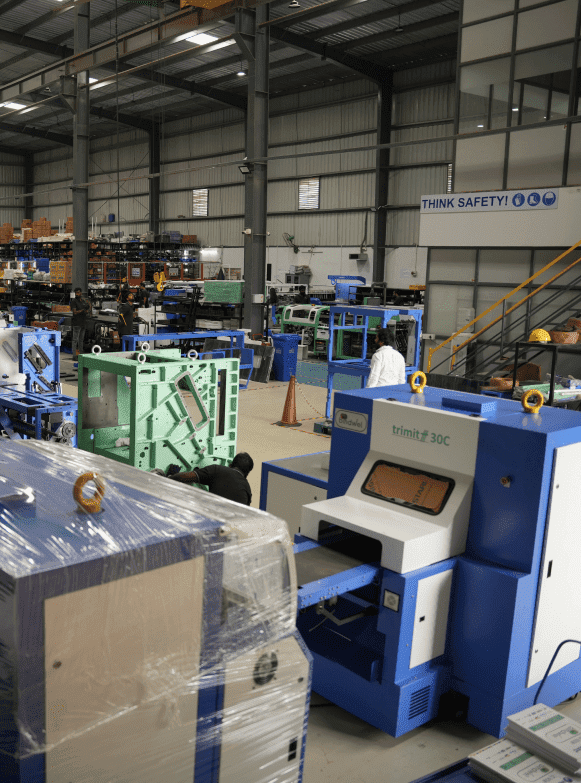
In perfect binding, strong books are not created by glue alone. The real strength of a bound book begins much earlier – at the perfect binder milling station.
For compact perfect binders designed for digital print environments, spine preparation becomes even more critical. Short-run books, variable thickness jobs, and digitally printed stocks require consistent fiber exposure for reliable adhesive bonding.
Digital print environments introduce variation every day.
Different book thicknesses, paper stocks, grain directions, and run lengths all place new demands on the binding process.
Yet customers continue to expect the same professional binding quality regardless of the job.
Delivering that level of consistency starts long before glue reaches the spine.
A well-designed perfect binder milling station ensures:
- Better glue penetration
- Stronger page pull strength
- Cleaner spine preparation
- More consistent binding quality
While many high-speed binders use aggressive roughening systems and deep milling adjustments, compact binders operate differently. Since the linear speed of smaller binders is comparatively lower, an optimized milling and notching system can achieve excellent results without requiring additional roughening tools.
Here’s how SigLoch ZEN‘s perfect binder milling station design makes all the difference in compact perfect binding systems.
1. Larger Milling Cutter Diameter Improves Spine Preparation
One of the most overlooked factors in spine preparation is the diameter of the milling cutter.
A larger perfect binder milling station offers several important advantages over smaller cutters commonly used in competing machines.
Better Cutting Geometry
A larger cutter creates a smoother cutting action with improved fiber exposure across the book spine.
Reduced Fiber Damage
Because the cutting angle is more gradual, paper fibers are opened cleanly rather than torn aggressively.
More Stable Operation
Larger cutters rotate more smoothly, resulting in consistent milling quality across different book thicknesses.
This becomes especially important in digital printing applications where books may include:
- Coated papers
- Toner-based prints
- Mixed media stocks
- Variable paper grain directions
A properly sized milling cutter ensures consistent spine preparation even under changing production conditions.
2. Higher Tooth Count Creates Cleaner Fiber Extraction
The number of teeth on the milling cutter directly affects the quality of spine preparation.
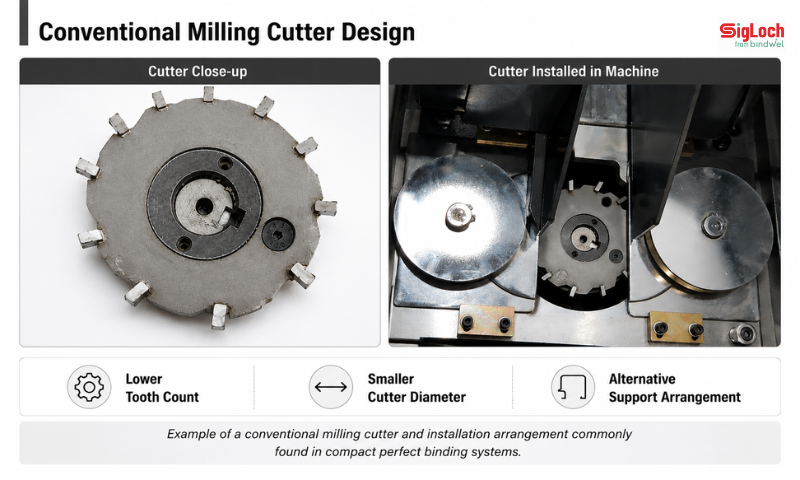
Many compact binders use cutters with fewer teeth, which can create:
- Uneven milling
- Aggressive cutting marks
- Inconsistent fiber opening
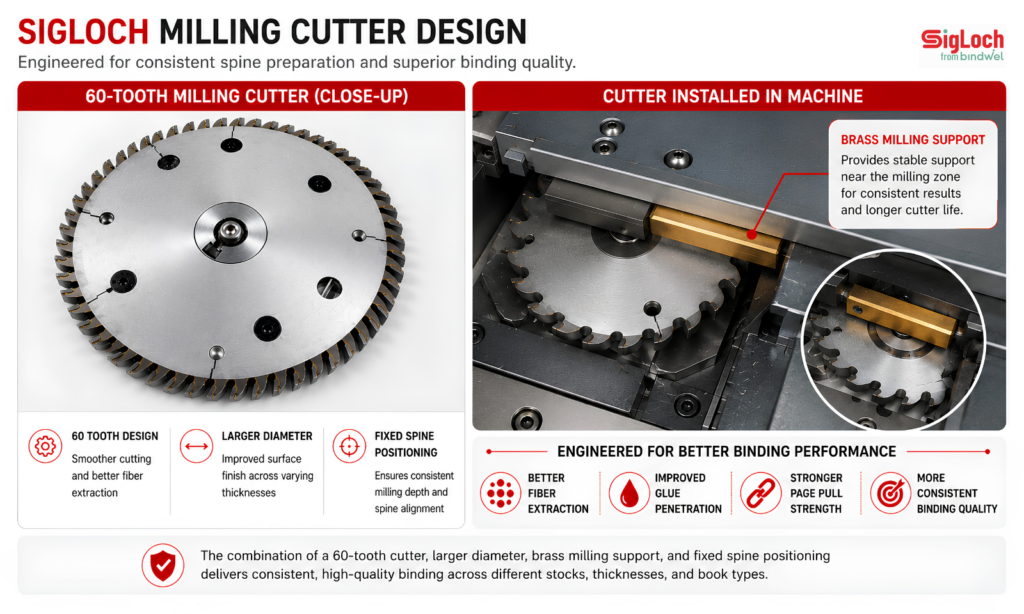
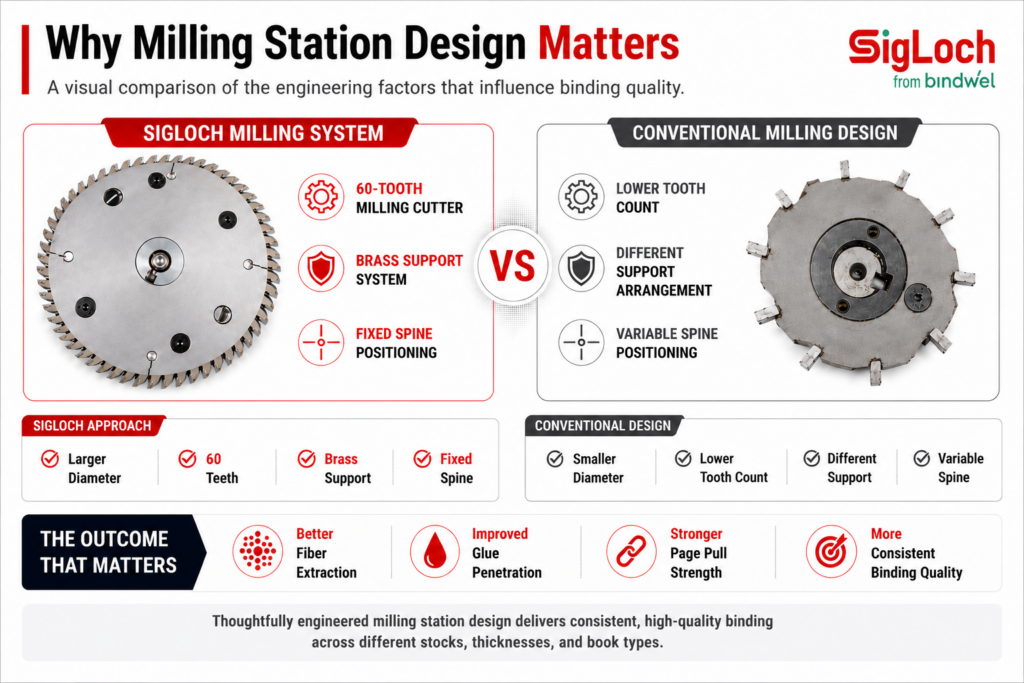
In contrast, a cutter equipped with 60 teeth delivers a much finer and more controlled cutting action.
Advantages of Higher Tooth Count
Cleaner Spine Surface
More cutting points create smoother and more uniform milling.
Improved Fiber Exposure
Paper fibers are opened consistently across the full spine width.
Reduced Spine Stress
Fine cutting reduces tearing and minimizes paper damage.
Better Glue Penetration
Uniform fiber extraction allows adhesive to flow more effectively into the spine structure.
The result is stronger and more reliable binding quality.
3. Intelligent Milling Movement Maintains Consistent Spine Position
One major challenge in perfect binding is maintaining consistent spine alignment across varying book thicknesses.
In many competing systems, books always pass through the exact center of the milling cutter. As book thickness increases, the rear support mechanism must continuously shift position to accommodate the changing spine backline. This means there is no fixed back support directly behind the cutter during operation.
Additionally, due to the smaller cutter diameter commonly used in such machines, it becomes difficult to position the back support close enough to the cutting zone. As a result, the paper fibers are not sheared cleanly in a true scissor-cutting action, leading to inconsistent fiber extraction and less effective spine preparation.
In contrast, our design keeps the book back position fixed while the perfect binder milling station opens only on one side according to book thickness. Combined with a larger diameter milling cutter and carbide-tipped back support positioned close to the cutter, this creates a true scissor-cut effect for cleaner cutting, superior fiber opening, and significantly improved adhesive penetration.
This creates inconsistencies in:
- Milling quality
- Glue application
- Cover alignment
Our design allows the perfect binder milling station to open only on one side based on book thickness, while keeping the book spine position fixed.
Why This Matters
By maintaining a constant book back position:
- Spine preparation remains consistent
- Glue application becomes more accurate
- Cover registration improves
- Binding quality becomes more repeatable
This design is especially beneficial in short-run digital print environments where book thickness changes frequently.
4. Carbide-Tipped Back Support Enhances Cutting Stability
Stable spine support is essential during milling.
Without proper support behind the cutter:
- Paper vibration increases
- Fiber extraction becomes inconsistent
- Spine preparation quality suffers
A carbide-tipped back support positioned behind the perfect binder milling station significantly improves cutting stability.
Benefits of Carbide-Tipped Support
Better Spine Rigidity
Keeps the book block stable during milling.
Cleaner Fiber Opening
Improves the consistency of paper fiber extraction.
Longer Wear Life
Carbide provides excellent durability under continuous operation.
Improved Cutting Precision
Helps maintain consistent milling quality over long production runs.
This additional support contributes directly to stronger adhesive bonding and cleaner finished books.
4A. Brass Support Improves Milling and Notching Consistency
In addition to cutter support, maintaining proper book block support near the milling and notching zone plays an important role in achieving consistent spine preparation.
A dedicated brass support positioned close to the perfect binder milling station helps stabilize the book block as it passes through the spine preparation process.
Why This Matters
Consistent Book Support
Helps maintain stable contact during milling and notching operations.
Improved Fiber Extraction
Supports cleaner and more repeatable fiber opening across varying book thicknesses.
More Reliable Notching Quality
Helps maintain consistent groove formation for improved adhesive anchoring.
Better Repeatability Across Jobs
Contributes to more consistent spine preparation when processing different paper stocks and book formats.
While often overlooked, proper support near the milling and notching zone plays an important role in maintaining consistent binding quality across changing digital print applications.
5. Optimized Milling and Notching for Compact Binder Applications
Unlike high-speed binders, compact perfect binders operate at lower linear speeds.
Because of this, aggressive roughening tools are not always necessary.
Instead, an optimized combination of:
- Precision milling
- Proper notching tools
- Controlled fiber extraction
can achieve excellent binding strength with reduced mechanical complexity.
Two Practical Milling Depth Options
The system is designed with two optimized milling settings.
Pad-Making Mode
Used for applications where spine removal is not required.
Minimum Milling Depth Mode
Designed for:
- Loose leaf sheets
- Single folded sections
- Digital print applications
This simplified approach ensures reliable operation while maintaining consistent spine preparation across a wide range of jobs.
Why Notching Tools Matter
Instead of using large notching discs, compact systems utilize precision notching tools that create controlled grooves in the spine.
These notches:
- Improve adhesive anchoring
- Increase page pull strength
- Enhance binding durability
Combined with proper milling, they provide strong and reliable bonding performance for digital print applications.
Consistency Matters More in Digital Print Environments
Unlike traditional long-run production, digital print environments frequently process books with changing specifications.
Different paper stocks, varying book thicknesses, mixed media applications, and shorter run lengths all introduce variation into the binding process.
Achieving offset-quality binding under these conditions depends on how effectively the spine is prepared before adhesive is applied.
That is why perfect binder milling station design, cutter geometry, spine positioning, support systems, and notching quality all play such an important role in modern digital perfect binding.
The Foundation of Strong Perfect Binding
In perfect binding, glue can only perform well if the paper fibers are properly prepared.
That preparation depends entirely on the quality of the perfect binder milling station.
Features such as:
- Larger milling cutter diameter
- Higher tooth count
- Fixed spine positioning
- Brass support near the milling and notching zone
- Carbide-tipped back support
- Precision notching tools
all contribute directly to:
✔ Better fiber extraction
✔ Improved glue penetration
✔ Stronger page pull strength
✔ More consistent binding quality
For compact digital perfect binders, efficient perfect binder milling station design is one of the biggest factors separating average binding from truly professional results.
✨ Want to learn more about advanced perfect binding technology and digital print finishing solutions?
👉 Follow Bindwel on Facebook, LinkedIn, Twitter, Instagram and YouTube for machine insights, engineering innovations, and expert tips on improving binding quality and production performance.