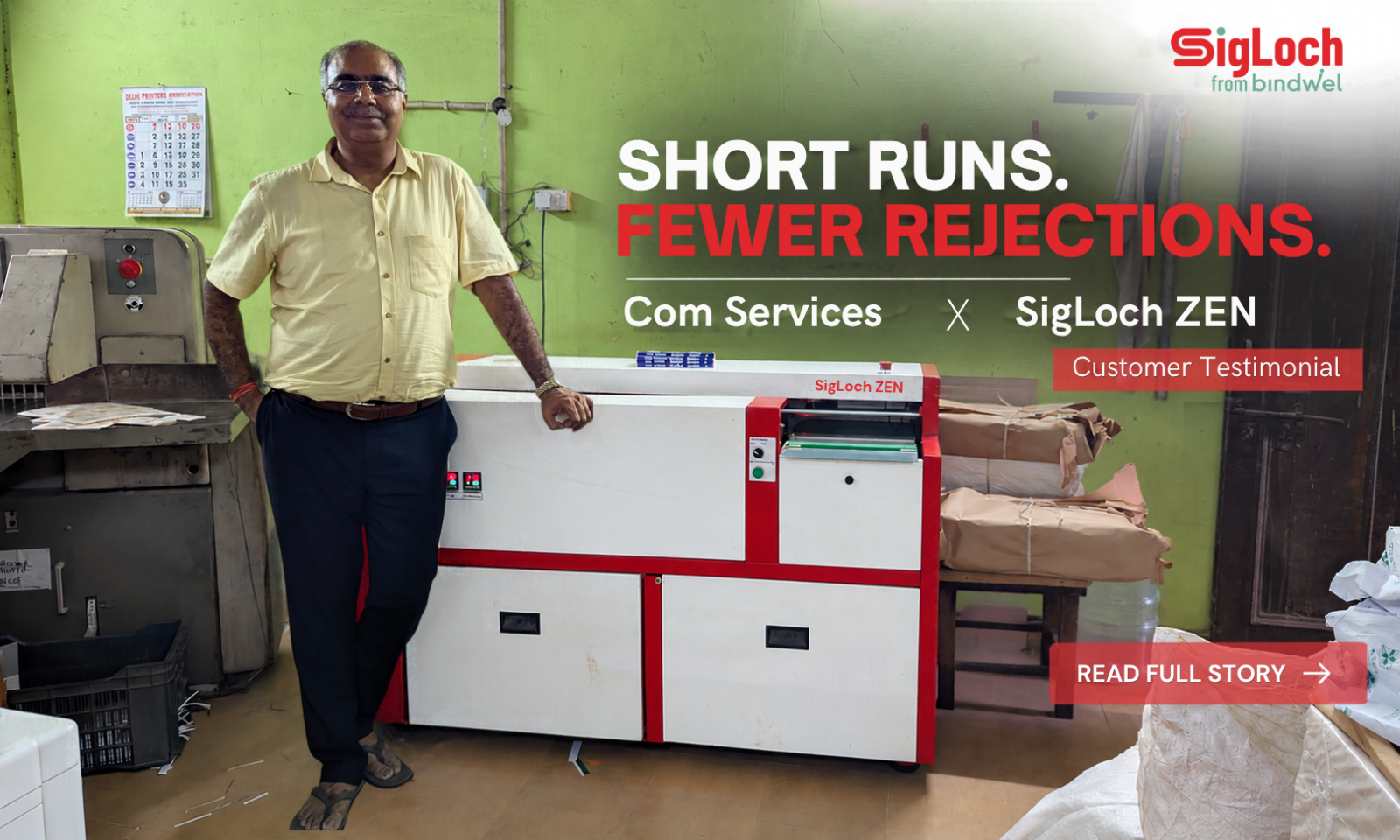
For Nivaara Graphics, a short-run bookbinding sample isn’t just a sample. It can be the step that gets a corporate order moving.
Based in Mumbai and working in corporate gifting, Nivaara develops customised pieces for corporate clients. When a customer needs to see a physical sample, getting it ready quickly can make a difference to how soon an idea moves towards an order.
This was particularly relevant for book samples. Before Nivaara invested in the SigLoch ZEN from Bindwel, creating a sample that looked like a finished perfect-bound book involved several manual steps.
From manual samples to short-run bookbinding
Nikhil, who represents Nivaara Graphics, recalls how these samples were made earlier. The pages would be stapled, double-sided tape applied, the sample laminated with 170 or 200 micron material, then cut and assembled by hand. The result could demonstrate the basic idea to a customer, but the staples remained visible and the finishing did not look like a properly bound book.
For Nivaara’s corporate-gifting work, this created a gap between the digital print and the finished sample. The requirement was not simply to show what the book might look like. The sample itself needed to represent the finished product.
Nikhil came across the SigLoch ZEN at PAMEX while looking for a faster way to produce a book. He asked whether a book could be made in two minutes. He had initially been sceptical, but the demonstration changed his view.
What stood out to him was the simplicity of the production flow: “I put the book in from here and it comes out from there.”
With the book block prepared, the SigLoch ZEN handles spine preparation, adhesive application and cover nipping, replacing the manual binding workaround Nivaara had previously used for samples. The machine is designed for short-run digital print applications and can handle loose leaves or single folds as well as thin and thick books.
When short-run book production becomes urgent
The value of that short-run bookbinding capability was soon demonstrated in an actual production requirement.
A school approached Nivaara with an urgent requirement for 300 books of each of two designs. Instead of depending on an outside binder, Nikhil and his brother were able to take up the production themselves, with the SigLoch ZEN supporting the job.
Nikhil’s description of the machine’s role is simple: “Your machine backed us up well too.”
The same capability is relevant when the requirement is much smaller. Nikhil says the machine can be used even when the requirement is only five or ten books. For a corporate-gifting business, where a client may need a sample or a small quantity rather than a large production run, this makes short-run book production practical for the workflow.
From book samples to customised corporate work
Nivaara’s production requirements extend beyond conventional book jobs. The company develops customised pieces for corporate clients, including notepads, chit pads and sticky notepads.
Nikhil also looks at products he comes across elsewhere and considers how they could be developed as samples for his customers. With the SigLoch ZEN available for short-run bookbinding, he can work with digital print and develop physical samples without recreating the earlier manual binding process each time.
This has opened up another role for the machine: not simply producing books, but supporting the process of developing and presenting new ideas to corporate customers.
Short-run bookbinding as part of the workflow
For Nivaara, the SigLoch ZEN has become part of a workflow where the requirement is not always a large book order. It can be a sample, a handful of books, or an urgent short-run requirement that needs to be handled without sending the work outside.
For Nikhil, the improvement is best described in his own words: “All those problems of mine went away.”
The previous process involved staples, tape, lamination and hand assembly. With the binding process handled by the SigLoch ZEN, Nivaara can move from the digital print to a finished bound sample without those earlier workarounds.
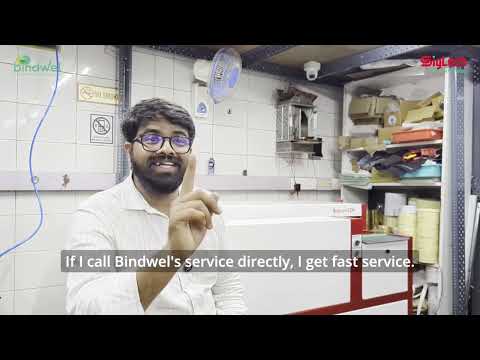
Nikhil also highlights the support behind the machine. He says that when he needs service, he can contact Bindwel’s service team directly rather than having the request routed through the sales side.
He believes this type of short-run bookbinding capability can also be useful for startups and smaller digital-print operations, particularly where the requirement may be only a few books. For Nivaara, the immediate application remains the development of samples and customised pieces for corporate customers.
For Nivaara’s corporate-gifting work, the difference is ultimately about being able to respond to a requirement without the manual workaround that was previously necessary. A book sample can now move through the binding process “fata fat”.
Nikhil’s final message to Bindwel reflects the importance he places on that support: “Please continue giving us service going forward – this is my trust in you.”

Explore short-run bookbinding with SigLoch ZEN
Nivaara’s experience shows how short-run bookbinding can become part of a broader digital-print and corporate-gifting workflow, from producing a single sample to handling an urgent small-quantity requirement.
See what SigLoch ZEN can do for your short-run digital print business.
👉 Follow Bindwel on Facebook, LinkedIn, Twitter, Instagram and YouTube for more customer stories, machine insights, and practical updates from the print floor