For a print-on-demand book producer, short-run jobs can come with their own production challenges. Book quantities may range from a few copies to a few hundred, while every finished book still needs to meet the expected quality standard. A perfect binding machine for short runs is a must.
For Com Services, a book printing and binding company based in Wazirpur, Delhi, this was an important consideration. The company has been involved in print-on-demand production for around 10 years, handling book quantities ranging from small orders to around 200-300 copies.
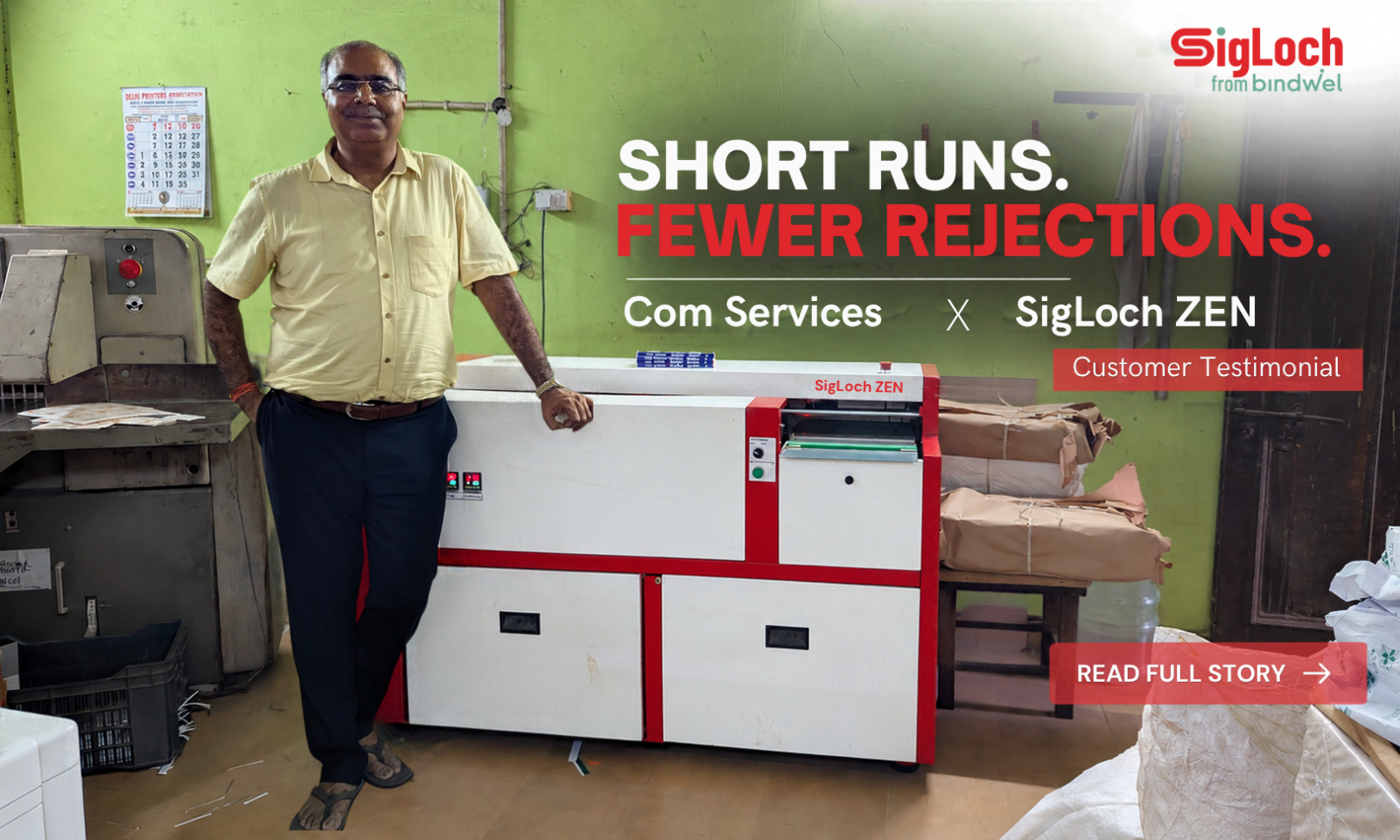
Ashish Kapoor, who represents Com Services, shares how the company moved from an older perfect binding machine to SigLoch ZEN, and how the change addressed some of the binding and support challenges they had experienced.
The Challenge of Binding Short-Run Books
Com Services operates in the print-on-demand segment, where production requirements can vary considerably.
According to Ashish, the company handles quantities ranging from small orders to 200-300 books. This makes reliable and consistent book binding particularly important.
Before SigLoch ZEN, Com Services was using a Chinese-made perfect binding machine. The machine itself was not the only challenge. Service and technical support had become a major concern.
When the machine developed problems, Ashish says there was no readily available engineer, support centre or spare-part support to help with troubleshooting.
For a business handling time-sensitive print-on-demand jobs, A perfect binding machine for short runs could create difficulties when a critical job needed to be completed.
When Binding Quality Leads to Rejection
Service availability was one challenge. Binding quality was another.
Ashish explains that, with the previous machine, nipping was sometimes not done properly or the spine was not prepared correctly. As a result, some books would open after binding.
These issues eventually led to rejection.
Com Services already carried out in-house quality checks, but Ashish explains that there was still a concern about defective books making their way to the publisher.
For short-run and print-on-demand production, where jobs may be completed in relatively small quantities, avoiding unnecessary rejection becomes especially important for a perfect binding machine for short runs. A binding issue can affect not just one book, but the consistency of an entire job.
Looking for a Different Perfect Binding Solution
With these challenges in mind, Com Services explored available machine options at an exhibition.
The search eventually led them to SigLoch ZEN.
For Ashish, the decision was not simply about replacing one machine with another. The new solution needed to address the practical problems they had experienced in their existing binding process.
That meant looking at the quality of the finished book, the consistency of the binding process, ease of operation and the support available when technical issues arise.
A More Automated Approach to Book Binding
One of the aspects Ashish highlights about ZEN is its automation.
He describes the machine as highly automated and says that its operation does not depend heavily on the skill level of the operator.
This was important for Com Services because it meant an operator could learn the machine progressively and become confident with it relatively quickly.
Ashish says that an operator who takes time to understand the machine can become confident in operating it within about a week.
He also points to the absence of complicated controls as an advantage. Rather than requiring operators to manage numerous critical buttons or numbers, the machine takes care of much of the process itself.
For a perfect binding machine for short runs, this ease of operation can be particularly relevant when production involves a changing mix of jobs and operators need to adapt quickly.
Reducing Rejection Through Better Binding
The most important change for Com Services appears to be the reduction in rejection.
Ashish says that since installing ZEN, the company’s rejection rate has become very minimal.
He also explains that when something does go wrong because of an operator error, the issue can be identified during quality checks and rectified.
This perfect binding machine for short runs gives Com Services greater confidence in the consistency of its finished books.
The result is particularly relevant to the company’s print-on-demand workflow, where the ability to produce smaller quantities without compromising binding quality is an important part of the production process.
From Spine Preparation to Finished Book Quality
Ashish also highlights the quality of the finished book produced on ZEN.
He refers to the machine’s ability to produce a square spine and carry out spine preparation processes such as notching and milling. He also points to the glue application system as part of the overall binding process.
The important point for Com Services is the finished result.
Ashish compares the output with the quality expected from a larger, full-fledged binding machine and says ZEN delivers a very good finished product.
For a company producing short-run and print-on-demand books, this combination of automation and finished-book quality can help bridge the gap between smaller production quantities and professional bookbinding expectations.
A Short-Run Binding Machine That Supports Business Growth
Com Services’ experience with SigLoch ZEN goes beyond solving a machine problem.
The company started with a need for better support and more reliable binding. It also needed to address rejection caused by problems in nipping and spine preparation.
With ZEN, Ashish says the company has seen a very minimal rejection rate and has found the machine easier to operate.
He also believes that the quality produced by ZEN can help enhance the business.
For Com Services, the investment represents a move towards a more automated and dependable approach to print-on-demand book production.
Why Com Services Chose SigLoch ZEN
Ashish’s experience points to several factors that mattered when Com Services evaluated a new binding solution:
- Print-on-demand compatibility: The company handles quantities from small orders to around 200-300 books.
- Binding quality: Better control of the binding process helps address issues that previously led to books opening.
- Reduced rejection: Ashish reports that the rejection rate has become very minimal since moving to ZEN.
- Automation: The machine is designed to reduce dependence on operator skill.
- Ease of operation: Ashish says operators can become confident with the machine relatively quickly.
- Spine preparation: Notching and milling contribute to the overall binding process.
- Finished-book quality: Ashish compares the output favourably with that of larger, full-fledged binding machines.
- Business potential: He sees ZEN as a decision that can help enhance the business.
A More Confident Approach to Short-Run Book Binding
Com Services operates in a segment where book quantities can change from job to job, but expectations for the finished product remain high.
Its experience highlights a common production challenge: finding a perfect binding machine for short runs that can deliver consistent book quality without making the process unnecessarily dependent on operator skill.
For Ashish Kapoor and Com Services, SigLoch ZEN has addressed that requirement through automation, simplified operation and a binding process that, according to his experience, has significantly reduced rejection.
The result is a binding setup that gives the company greater confidence in its print-on-demand book production.
👉 Follow Bindwel on Facebook, LinkedIn, Twitter, Instagram and YouTube for Digital Print Asia 2026 and machine insights, and practical updates from the print floor