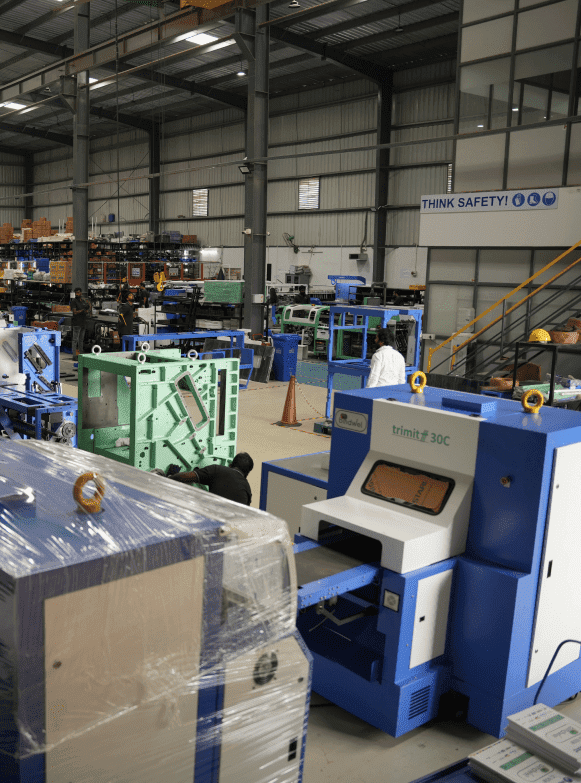
Many book plants were not designed in one go. They grew. A press arrived, then a folder, then another binding line, each placed wherever the building allowed. The Next Book Factory, built on an empty floor, is a different exercise, and it is the one Bindwel, Henkel and PrintWeek have put on the table for the fourth Publisher–Printer Roundtable.
On Friday, 27 November 2026, a panel of leading book printers will sit down at India Habitat Centre, New Delhi, to answer one question: if you were building a book factory today, what would you do differently? This post covers the format, the eight Next Book Factory questions, the panelists and the thinking behind the evening.
Why the Next Book Factory is back on the table
Many book production facilities have grown by addition. More presses, more folding equipment and more binding lines were added as the business grew. The result is a plant that works, and that still carries avoidable handling, work-in-progress, waiting and late-stage defect detection.
The 2025 Roundtable looked at the failures that can occur in book manufacturing, under the title Book of Mistakes. The 2026 conversation takes the next step. Having looked at what goes wrong, how do we shape a plant in which the same failures become less likely?
The question is what experienced owners would do differently with everything they have learned. The Next Book Factory is easiest to discuss with people who have run a factory, which is why the panel is made up of book printers.
The central question behind the Next Book Factory
The panel works from one question: how do we build a book factory that can respond predictably to an increasingly unpredictable publishing world?
Publishers manage large numbers of titles, varying quantities, seasonal peaks and urgent reprints, and demand for a title can change overnight. They also want to carry less inventory while keeping books available. From the printer, that comes down to four expectations:
- Predictability: turnaround that is met every time. A dependable twelve-day commitment is worth more than a seven-day promise that becomes fifteen.
- Consistency: the same quality from one job to the next.
- Flexibility: a quick response when plans change.
- Scalability: room to grow without rebuilding the plant.
A related question will also be put to the room. If the publisher is the customer and the printer is the service provider, does the printer have the liberty to present a menu card of the products it can service?
How the evening runs: a panel, an open house and dinner
The evening has three parts. A moderator-led panel of 75 minutes works through eight questions. A 30-minute open house follows, where publishers and other guests take the floor. Dinner closes in the evening, so the conversations can continue informally.
Panelists receive the eight questions in advance. No formal presentations are expected, although photographs, factory layouts or practical examples are welcome if they help. The aim is a candid, experience-driven exchange about the Next Book Factory rather than a series of prepared speeches.
For each question, the moderator invites short responses from the printers and makes room for differing views. Bindwel’s role is to convene and facilitate. The discussion does not centre on any particular machine, technology or supplier.
The eight questions for the Next Book Factory
| # | Topic | The question |
|---|---|---|
| 1 | Business and markets | If you were starting afresh, which markets would you focus on: educational, trade, exports, premium or commercial printing? Would you specialise or diversify? |
| 2 | Print technologies and hybrid capabilities | Would you invest in digital, web offset and sheetfed offset? Would you build a hybrid factory or focus on selected technologies? How does the choice change for educational, trade, magazine and coffee-table books? |
| 3 | Factory layout and space | Given the cost and availability of industrial space in India, how would you design the factory to optimise space, material movement, storage and future expansion? |
| 4 | Workflow and production planning | How would you organise the workflow from order receipt to printing, binding, finishing and dispatch, and minimise bottlenecks and work-in-progress? |
| 5 | Machinery and investment | Which equipment would you prioritise? Where would you invest more, and what would you avoid or postpone based on experience? |
| 6 | People and expertise | How would you build the right team, develop skills, structure supervision and reduce dependence on a few highly experienced individuals? |
| 7 | Quality assurance | How would you build quality into every stage, reduce waste and rework, and keep output consistent across different types of books? |
| 8 | Productivity and future readiness | What would you do differently to improve productivity, utilisation and profitability while preparing for automation, changing run lengths and future customer expectations? |
Layout and workflow deserve a closer look, because they are where the Next Book Factory shows up on the floor. The discussion will ask where space, movement, waiting and handling are using up time without adding value to the book, and how a title should travel from prepress through printing, folding, gathering, binding, trimming, inspection, packing and dispatch.
Who is on the Next Book Factory panel
- Shashi Ranjan, Chief Executive Officer, Manipal Global Print Solutions
- Anil Rego, Managing Director, Brilliant Printers
- Manu Choudhury, Director, CDC Printers
Publishers, book printers, next-generation leaders and selected industry specialists join the room alongside them.
What the open house adds to the Next Book Factory conversation
After the panel, the floor opens for 30 minutes to publishers, book printers, production professionals, technology providers and other participants. Publishers bring the customer’s side of the story, which is where the Next Book Factory meets what the market asks for. Topics they are invited to raise include:
- Changing print-run lengths and delivery expectations.
- Quality consistency, specifications and binding durability.
- The need for flexibility across educational, trade and premium books.
- How printers and publishers can work together to reduce cost, waste and turnaround time.
The moderator will also invite the printers on the panel to respond to one another’s views and experiences.
Themes the room will carry beyond the eight questions
A few threads:
- Visibility. Can a publisher know where an order stands without chasing the printer? Information flow between publisher and printer is part of the Next Book Factory as much as machine layout is.
- Short runs and reprints. How quickly can an urgent reprint of 1,000 or 2,000 copies return to the production schedule, and how small can an economical run become? How should offset and digital work together?
- Simplify before you automate. Does a process need to be automated, or does it need to exist at all? Changes in materials, adhesives, book construction and finishing can sometimes remove a handling or waiting step.
- People and productivity. Where does human judgement create the most value, and which repetitive, error-prone activities should the process take over?
- From mistakes to continuous improvement. Which errors can be prevented at source rather than detected later, and where can in-process verification, traceability, vision or barcode and QR recognition help?
- The next generation’s factory. One thing from the previous generation’s factory that should be preserved, and one thing that should change.
The evening ends with a practical question: what is one change we can start on Monday morning towards the Next Book Factory?
Event details for the Next Book Factory roundtable
- Date: Friday, 27 November 2026
- Time: 7:00 PM onwards
- Venue: Tamarind, India Habitat Centre, Lodhi Road, New Delhi
- Format: Invitation only, followed by cocktails and dinner
- An initiative of: Bindwel, Henkel and PrintWeek
Join the Next Book Factory conversation on 27 November
The best answers on the Next Book Factory come from people who have built and run plants, and from the publishers who depend on them. To see the panelists and updates from the evening, follow Bindwel on LinkedIn.