Digital print bookbinding is the stage nobody budgets for until a rush job sits in the bindery overnight. On 25 September, at Digital Print Asia 2026 in Bengaluru, our CEO of SigLoch, Kishore stood in front of the Press to Publish track session and made one argument: the press is ready, and the bindery needs work.
Bindwel was a Silver Partner at the event, held at the Hilton Manyata Business Park. Our slot was Session 4, Breakout BR2, 2:00 to 2:45 PM. The title was Binding at the Speed of Digital.
This post walks through the digital print bookbinding numbers from that session, one at a time. You can run the same check on your own plant tomorrow morning.
Why Digital Print Bookbinding Became the Bottleneck
Follow one order through a modern book plant. The customer places it on a web portal. The system writes a job ticket. Prepress imposes the file. The digital press prints it with zero makeready between jobs. Nobody touches the job yet.
That journey shows where digital print bookbinding eats your time. The first four stages run on data. The last two still run on people.
Then it reaches the binder and the trimmer. An operator walks over and sets size and thickness by hand. That manual set-up takes around six minutes per job.
Six minutes sounds small until you multiply it. At 200 short jobs a day, you spend 20 hours on set-up. That is longer than the shift. (The 200 is an illustrative figure. Count your own.)
This is the hidden cost of digital print bookbinding done by hand. Your press never waits on it, and your customer always does.
- Press makeready between jobs: 0 minutes
- Manual bind-and-trim set-up per job: about 6 minutes
- Set-up across 200 jobs a day: 20 hours
💸 The Changeover Tax in Digital Print Bookbinding
Take the same 1,000 books a day and change only the mix. Variety is the number of different titles you run. Quantity is the copies of each. The model rates the binder at 1,000 books an hour and charges six minutes of manual set-up for every new title.
| Daily mix (titles × copies each) | Hours to bind 1,000 books, manual set-up |
|---|---|
| 1,000 × 1 (pure POD) | 101 hours |
| 100 × 10 | 11 hours |
| 1 × 1,000 (the old offset run) | about 1 hour |
Illustrative model. Every mix totals 1,000 books.
The top row cannot happen. 101 hours do not fit inside a day. The bottom row shrugs off the set-up.
Look at the middle row, because most short-run plants live there. 100 titles of 10 copies take 11 hours by hand, which is longer than a shift. Switch to a ticket-driven changeover and the same day finishes in just over an hour.
Variety drives the cost. Every new title triggers a changeover, and every changeover burns minutes you cannot bill. Digital print bookbinding makes that tax visible, because digital orders arrive in many titles and few copies.
Two Paths to a Book Block
The press decides how the book block forms. Both paths can still make a book of one.
- Path A, sheetfed toner: Sheets come off already cut and collated in sequence. The loose-leaf block goes straight to the binder.
- Path B, inkjet web: The roll gets cut into sheets, or folded into sections of 8 to 16 pages.
Digital web widths give small sections, and 8 to 16 pages is the norm. The 32-page signature is an offset habit. For POD on a web, cut-sheet block forming is the usual route.
Whichever press you own, every block lands at the same station: the perfect binder. Digital print bookbinding throughput gets won or lost there.
Matching Digital Print Bookbinding Capacity to Your Press
Digital print bookbinding capacity has to match what the press hands over. How many books is that? The session answered with one 250-page book on a plant-working basis: six productive hours in each eight-hour shift, three shifts a day.
| Engine | A5 books/hour | A5 books/day | A4 books/hour | A4 books/day |
|---|---|---|---|---|
| Toner, cut-sheet, 180 ppm | 86 | 1,555 | 43 | 778 |
| Inkjet web, 20 in, 150 m/min | 945 | 17,008 | 472 | 8,504 |
| Inkjet web, 20 in, 180 m/min | 1,134 | 20,409 | 567 | 10,205 |
The formula behind the table: books per day = (press pages per minute ÷ pages per book) × 60 × 18 productive hours.
One INSTA perfect binder, running with the TRIMIT SRT trimmer, binds up to 1,000 books an hour. That absorbs about twelve toner engines. It also keeps pace with one 20-inch web at 150 metres a minute.
Push the web to 180 metres a minute and a single INSTA runs out of room. Freedom 2K, at up to 2,100 books an hour, picks up from there. Confirm every rating against your own trim sizes, stocks and spines before you plan around it.
The Finishing Stack: Where the Ticket Breaks
Picture four layers. The job ticket flows down. Machine status flows back up.
- Layer 1, customer interface: web portal, mobile order app, publisher CMS, trade upload API
- Layer 2, MIS and workflow: MIS, JDF ticket engine, job scheduler, cost and billing
- Layer 3, prepress, DFE and RIP: preflight and imposition, digital front end, colour management, press queue
- Layer 4, shop floor: digital press, cover finishing, book block making, then the INSTA binder and the TRIMIT SRT trimmer
Layers 1 to 3 are software, and most plants already own them. In many plants the ticket stops before layer 4. If it stops at the press, digital print bookbinding goes back to manual set-up.
Three Archetypes of Digital Print Bookbinding
Choose your finishing by your mix of variety and quantity. Every digital print bookbinding plant sits somewhere on a log scale of copies per title, and three archetypes mark the scale.
- A, POD and book-of-one: 1 to 5 copies per title, variety very high. A QR code on the block and the cover, no batching by size, set-up from the ticket.
- B, short run: 25 to 500 copies, variety moderate. Batch by paper and cover finish, recall settings from job memory, change over in under a minute.
- C, the 1,000-plus world: variety is low. Plan by title, gather inline, and let one set-up serve the whole run.
Most printers run all three at once, so one digital print bookbinding machine rarely fits the whole floor. Buying one machine to serve all three is the common mistake.
Which Bindwel Machine Fits Each Archetype
Digital print bookbinding calls for a different machine at each point on the scale. Rated speed is what you buy. Changeover behaviour is what you get to use.
- INSTA for POD: up to 1,000 books an hour with the TRIMIT SRT trimmer. It binds a single copy, matches each block to its cover by QR, and takes settings from the ticket with no stop.
- PUReBind Ultra for short run: a single-clamp PUR binder for 3 to 50 mm spines. It suits photobooks, catalogues and coated stocks where hotmelt fails, and it auto-sets from book thickness, so nobody dials in settings from job to job.
- Freedom 2K for larger runs: up to 2,100 books an hour with QR changeover in under a minute.
The Bindwel POD Cell: INSTA Plus TRIMIT SRT
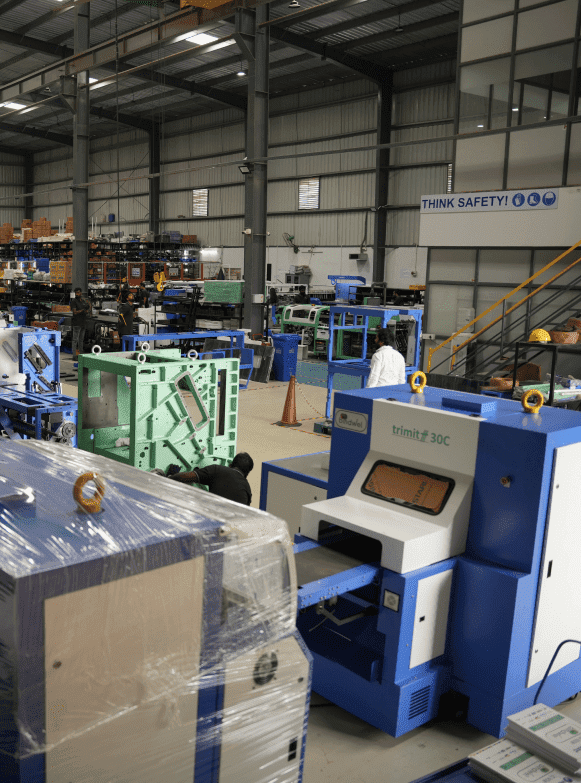
The session paired two machines into one cell. That cell is our answer to digital print bookbinding for book-of-one orders. INSTA binds the next book, whatever it is. TRIMIT SRT trims it. Nobody stops the line in between.
What INSTA does:
- Matches the QR on the block to the cover in the feeder. On a mismatch the clamp stays shut, so the wrong book cannot get bound.
- Pulls milling depth, glue and spine from a JDF ticket, the HMI job memory or a data-matrix code.
- Runs consecutive books with different spine widths and never stops the line.
What TRIMIT SRT does:
- Reads thickness from the ticket and sets it, with no operator input.
- Trims with a servo-driven three-knife system at ±0.5 mm repeatability across changeovers.
- Programs cut positions on all three sides.
- Changes trim size through a quick, tool-free set-up. JDF-driven trim size sits on the roadmap, and we say so.
Real plants already see the effect. One Mumbai printer running Freedom 2K cut changeover from 15 to 20 minutes down to under a minute, and moved from a handful of jobs a day to 25 or more.
Order to Dispatch in Four Hours
Here is one book on the POD clock, from order to the loading bay. This illustrative target state shows where digital print bookbinding sits in the day: inside the finishing window, between the press and the box.
- T+0: Order placed, specs locked on web-to-print
- T+5 min: Job ticket issued, PDF validated, JDF created
- T+30 min: Prepress imposes the file and queues it to the DFE
- T+2 hr: Block and cover printed with no makeready
- T+3 hr: Cover finished, with lamination or UV set by the ticket
- T+3 hr 45: Book bound and trimmed, INSTA matching by QR and TRIMIT SRT trimming
- T+4 hr: Packed, with the label printed from ticket data
Every minute you save in the finishing window is a minute you can sell as a shorter delivery promise.
Three Ways to Connect the Bindery
You do not need a full JDF project to start digital print bookbinding on a connected line. One ticket carries everything a machine needs: trim 152 × 229 mm, 320 pages with a 17 mm spine, 70 gsm text, a 300 gsm matt-laminated cover, quantity one, ship-to Chennai. The same job ID prints as a QR on the block and the cover.
JDF carries the instructions out to each machine. JMF carries status back to the MIS, so nobody walks the floor to find a book.
- HMI job memory: the QR on the book recalls settings from an Excel job library loaded on the HMI. No IT project. Start here.
- Live JDF fetch: the QR sends the job ID, and the machine pulls live ticket data and reports status back. You get a full audit trail and live status.
- Embedded settings: every machine setting sits inside the QR or data-matrix code. It works offline and standalone.
Start at option 1. Option 2 is where the audit trail and live status come from.
Size Your Digital Print Bookbinding Line Before You Buy It
You can finish this exercise in five minutes. Take the last 90 days of orders and skip your best month. Count four things per day: titles, copies per title, distinct trim sizes and cover finishes. Variety is your real changeover load.
Then answer two questions.
- More than about 40 titles a day? Automate changeover first. That points to INSTA with ticket-driven set-up.
- Fewer titles, but more than about 1,000 copies per title? Automate at scale with Freedom 2K, up to 2,100 books an hour with QR changeover under a minute.
- Neither? A short-run binder such as PUReBind Ultra fits.
The rule behind it: buy changeover speed before you buy running speed.
What Else the Room Covered at Digital Print Asia 2026
Digital Print Asia ran across 24 and 25 September in Bengaluru. Next to our session, speakers covered the economics of digital print, a panel on the Asian market, the economics of book production, how publishers and printers can work together, content security, the global book market and where AI fits, and the mechanics of digital print bookbinding itself. We will unpack several of these in upcoming posts.
Your Next Move: Bring Your Order Book
The press is ready. The bindery is the open question, and digital print bookbinding is where you answer it. Run the five-minute count on your last 90 days of orders and you will know your changeover load before anyone sells you a machine.
Here is how we work with you on digital print bookbinding from there:
- Bring 90 days of order data.
- We model your changeover load with you.
- You pilot one live POD cell before committing the whole bindery.
Follow Bindwel on our social media pages for more from Digital Print Asia 2026 and the next posts in this series.
👉 Follow Bindwel on Facebook, LinkedIn, Twitter, Instagram and YouTube for Digital Print Asia 2026 and machine insights, and practical updates from the print floor