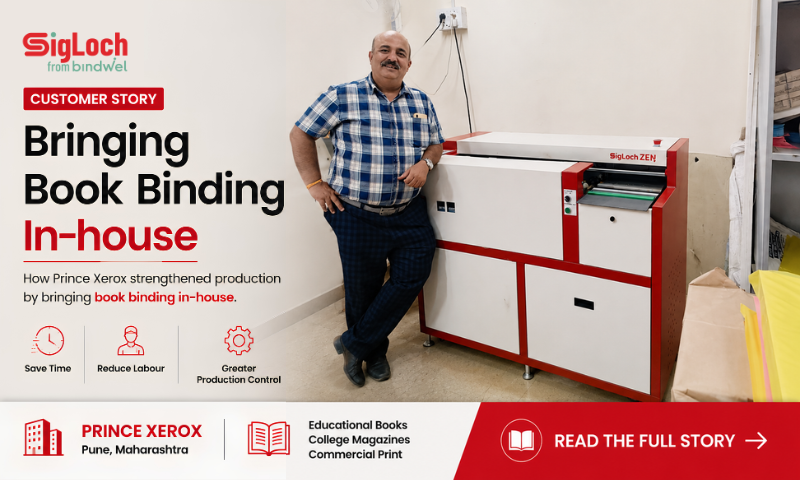
Printed sheets move steadily through the production floor at Prince Xerox, where in-house book binding now forms part of the company’s daily workflow. Educational books, college magazines and other commercial print jobs move from press to binding and final dispatch within the same facility. Until 2025, however, binding was the only stage that remained outside the company’s control, with finished book blocks travelling out for binding before returning for dispatch. As production volumes increased, bringing binding in-house became the next logical step.
Established in 1988 in Pimpri, Pune, Prince Xerox operates from a 1,000 sq. ft. production unit with a team of 15. The company serves around 30 to 50 customers and produces between 2,000 and 3,000 books every month. Throughout its growth, it has worked towards keeping production “all under one roof,” allowing printing and finishing to move through a more connected workflow.
Bringing In-house Book Binding into the Production Workflow
The decision to adopt in-house book binding was driven by a practical production need rather than an expansion plan. Outsourced binding added another stage to every book order, making delivery planning more difficult as workloads increased.
To address this, Prince Xerox installed the SigLoch ZEN in 2025. The company selected the machine for four reasons it identified during evaluation: quality, the confidence of choosing an Indian-built product, its compact footprint and its ease of operation. These factors suited an established commercial print environment where floor space and straightforward day-to-day operation are equally important.
How the Machine Fits Daily Production
Today, in-house book binding allows printed sections to move directly from press to binding without leaving the premises. The production team can schedule printing, binding and dispatch within a single workflow, reducing dependence on external finishing.
The compact design integrates comfortably into the existing shop floor, while the straightforward operation allows the team to handle regular production efficiently. Features such as spine preparation, controlled adhesive application and cover nipping support the binding process, but their value is reflected in how naturally they fit into everyday production rather than in technical specifications alone.
Observable Changes on the Shop Floor
The most immediate benefit reported by Prince Xerox has been significant savings in both time and labour. By introducing in-house book binding, the company has removed an outsourced production stage and simplified the movement of books through its workflow.
Rather than coordinating with an external binding vendor, production can now continue from printing to finishing within the same facility, giving the team greater control over day-to-day scheduling.
Educational Books Continue to Drive Production
Educational books remain a regular part of Prince Xerox’s production schedule, alongside commercial printing work and college magazines. The company also highlighted a recent educational book project as one of the jobs it is particularly proud of. Although production quantities and turnaround details were not shared, these projects reflect the type of work now supported through its in-house book binding workflow.
Completing printing and binding under one roof has given the team greater flexibility in planning production. Instead of factoring in an external binding schedule, jobs can move through finishing as part of the normal production routine, making it easier to coordinate multiple orders across the day.
Practical Support Beyond Installation
For Prince Xerox, the installation was followed by continued technical support from the Bindwel team. The company described the service as prompt and timely, noting that this experience gives it the confidence to recommend Bindwel to other printers considering in-house book binding.
Reliable support is especially important for digital printers where production schedules leave little room for delays. Quick access to technical assistance helps keep work moving when every delivery commitment matters.
Looking Ahead
Prince Xerox believes the Print-on-Demand (POD) segment will continue to influence the future of commercial printing. As print runs become shorter and customer expectations continue to evolve, the company expects greater demand for flexible production workflows that keep printing and finishing within the same facility.
The company plans to grow its business by three to five times over the next five to ten years. With in-house book binding now established as part of its everyday production workflow, Prince Xerox is focused on building that growth on a production model that gives it greater control over quality, scheduling and delivery.
Rather than changing the way the company prints books, in-house book binding has changed the way those books move through production. What was once an outsourced process is now part of a connected workflow, allowing Prince Xerox to complete more of its work under its own roof while preparing for the next phase of growth.
👉 Follow Bindwel on Facebook, LinkedIn, Twitter, Instagram and YouTube for more customer stories, machine insights, and practical updates from the print floor