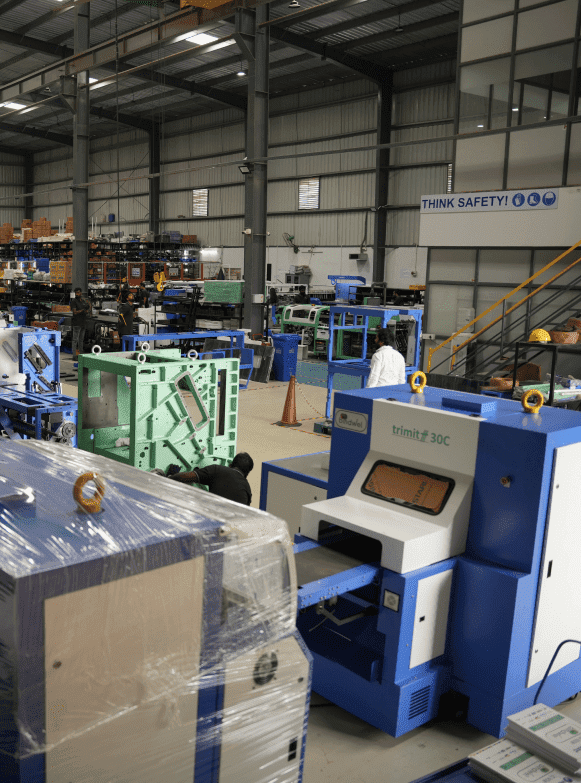
When a print shop switches to a digital flatbed cutting machine, everything changes. Across India—Kolkata, Indore, Thrissur—print companies are discovering something simple: the right finishing solution fixes what used to break their workflow.
The SigLoch XE-CUT Pro Xtend from Bindwel is built for this. It’s made in India, serviced in India, and understands how Indian print shops actually work.
For shops tired of outsourcing finishing, or stuck waiting for external vendors to deliver, this machine does one thing: it brings the entire process in-house.
The Problem Print Shops Face
Every print shop knows this feeling: your digital press churns out 1,000 sheets per hour. Beautiful sheets. Perfect color. Spot-on registration.
Then finishing happens.
Manual cutting. Manual creasing. Manual everything. Suddenly a 900-unit order takes 18 hours to finish instead. Your operators are tied up. Delivery deadlines for your custom packaging orders get delayed. Your customer waits.
Or you outsource. Hand it off to a vendor. You lose control. They may take weeks. Your margin gets cut 30-50% because they add a premium. You have no idea what quality you’re getting until it’s too late.
This is the bottleneck most print shops accept as normal. It doesn’t have to be.
What Manual Finishing Actually Costs
Let’s be blunt about what’s happening:
Your throughput stalls. Manual feeding is reducing your productivity. A skilled hand-finisher does 50-80 units per hour. Do the math on a 2,000-unit order. That’s 20-40 hours of labor tied up on one job.
Quality suffers. Every piece is slightly different. One crease is deeper, one cut is off by 0.5mm, one edge is rougher. For premium products—wedding invitations, luxury packaging, corporate gifts—this is unacceptable.
Your margin disappears. Outsourcing vendors charge 30-50% premiums. On thousands of units annually, you’re giving away thousands of rupees for nothing.
A digital flatbed cutting machine cuts through all three problems at once: machine speed, repeatable precision, in-house control.
How a Digital Flatbed Cutting Machine Actually Works
The SigLoch XE-CUT isn’t a basic guillotine. Here’s what it actually does:
Picks one sheet perfectly, every time. Load up to 150mm of sheets into the auto-feeder. The vacuum system grabs the top sheet. Then the next. Then the next. No waiting for your operator to load sheets one-by-one for eight hours straight.
Cuts with 0.1mm accuracy. Every cut is identical. Not close. Not “good enough.” Identical. Over 1,000 pieces. That’s offset-press quality in a digital workflow.
Executes cuts, kiss cuts, creases, and V-grooves in one pass. You don’t need three machines. You need one.
Recognizes your job from a QR code. Scan the code. The machine knows your settings. Setup takes 5 minutes instead of 30. For shops doing 30-50 jobs a day, that’s hours of reclaimed time.
Handles anything up to 600 GSM. Paper, cardstock, stickers, magnetic sheets, transparent films. One machine replaces three.
Runs at 1200 mm/s without breaking a sweat. Fast enough that same-day delivery stops being a fantasy.
This is why shops that get this digital flatbed cutting machine usually say the same thing: “I should have done this five years ago.”
What’s Actually Happening at Three Shops
Kolkata: Out with Outsourcing
A print shop in Kolkata did one thing: they cut out the middleman. They used to send short-run finishing jobs to external vendors. Weeks of turnaround. No control. They installed a digital flatbed cutting machine.
Now? They own the entire process. A 2-4 day turnaround instead of weeks. They expanded into box production and gift items. Jobs that never made sense before—because they required outsourcing and reduced their margins—suddenly make sense in-house.
One operator. Same person who used to hand-cut sheets. Now they load the machine and walk away, free to focus on printing more. The machine does the work.
Indore: Precision for Wedding Invitations
A luxury wedding invitation studio operates on razor-thin margins. One crooked crease ruins an entire batch. One misaligned cut tanks the whole order.
They got a SigLoch XE-CUT. A customer ordered 100 premium invitations with 1mm-precision cutting, kiss cutting, and creasing. That’s the kind of job that used to make them nervous. Now? Completed flawlessly. Delivered on deadline.
The local service support mattered. When something breaks, Bindwel shows up. They train the team. They’re actually reachable.
Thrissur: A 6-Hour Order
A small print shop in Thrissur has five employees. One of their customers needed 500 custom carton boxes. That’s a half-day, all-hands job for outsourcing. Could take weeks.
They ran it on the SigLoch XE-CUT. Six hours. Done. Delivered the same day.
That single job opened a new market segment for them. Packaging. Custom shapes. Work they never could have taken on before because outsourcing reduced their productivity and made it unprofitable.
Why Made-in-India Manufacturing Matters
You could buy a Digital Flatbed Cutting Machine from Germany. You could buy one from Japan. But here’s what you wouldn’t get: someone who shows up the same day when it breaks.
Response time. Your machine goes down at 10am. Bindwel’s service team is on-site by lunch. That’s not a luxury. That’s survival for a shop running on tight schedules.
Spare parts availability. You need a replacement head. You get it the next day, not three weeks after international shipping.
Training. Bindwel’s engineers visit regularly. They teach your team new applications. They explain what the machine can do. Nobody else does this.
Understanding how Indian shops actually work. They know your material sourcing challenges. They know your turnaround expectations. They engineered a machine for you, not a generic export model.
Pricing that makes sense. A machine built in India costs less than one shipped halfway around the world. That margin difference matters when you’re evaluating ROI.
How to Pick the Right Machine
Not all flatbed cutters are the same. Here’s what actually matters:
Accuracy. Can it hold ±0.1mm or better? For materials under 300 GSM, this is non-negotiable.
Speed. 1000mm/s or faster. Anything slower and you’re not actually saving time on high-volume jobs.
Material range. Make sure it handles your full range—paper, cardstock, stickers, magnetic sheets, films—up to 600 GSM.
Automation. Auto-feeder and QR code scanning should both be there. These are the features that free up your operator’s time so they are free to focus on printing more.
Service. Is the manufacturer local? Can they respond to breakdowns fast? Can you actually reach someone?
Training. Will they teach your team? Or do you get a machine and a manual and you’re on your own?
What’s Possible Now
Print shops that switched over aren’t fantasizing. They’re running faster. They’re taking on jobs they couldn’t before. They’re saying “yes” to customers instead of “no.”
The shops in Kolkata, Indore, and Thrissur? They didn’t invent anything. They just fixed a problem that everyone in the industry accepted as unsolvable.
In-house finishing. Same-day turnaround. Precision quality. Controlled margins.
You don’t have to outsource. You don’t have to wait for vendors. You don’t have to compromise.
The Bottom Line: Stop Waiting for Outsourcing
Print finishing doesn’t have to be your bottleneck. It can be your advantage.
If you’re serious about competing on speed, precision, and actually keeping your margins intact, a digital flatbed cutting machine is the move.
The question isn’t whether you need one. It’s whether you can afford another year of doing it the old way.
👉 Follow Bindwel on Facebook, LinkedIn, Twitter, Instagram and YouTube for more customer stories, machine insights, and practical updates from the print floor