Digital print finishing solutions has moved ahead. Finishing hasn’t kept the same pace.
Walk into a digital print shop today and the work rarely follows one pattern for long.
One hour it is books. The next it is a mockup. Then a wedding card. Then a short-run job that needs to move quickly.
That is the reality many printers are working in now.
Digital printing has already adapted to this shift. Post-press is still catching up.
That is the gap this blog is about.
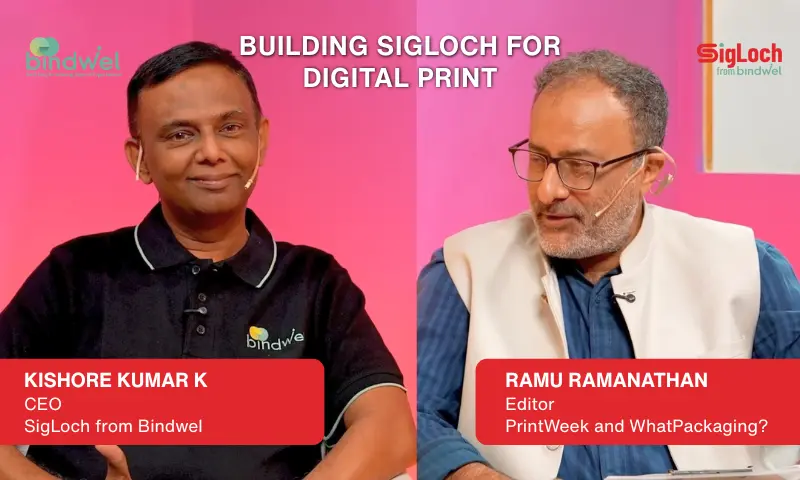
At PAMEX India 2026, Kishore Kumar K, CEO of SigLoch, spoke with Ramu Ramanathan of PrintWeek India about how digital print shops have changed, and how has not kept pace.
Digital printing has moved ahead. Finishing hasn’t kept the same pace.
That observation sits at the center of this shift in digital print finishing solutions.
The Shift Is in the Job Mix
The pressure on printers today is not just about volume.
It is about the kind of work they are expected to finish.
A typical shop now handles:
- Books
- School and publisher work
- Wedding cards
- Packaging samples
- Mockups
- Display pieces
- Customized jobs
All within the same setup. Often within the same day.
Older finishing setups were built for repeatability.
Digital print demands adaptability, and this is exactly where digital print finishing solutions are becoming essential.
What the Shop Floor Feels First
The problem usually shows up as friction.
- A job needs manual correction
- A format change takes longer than expected
- A custom requirement has to be outsourced
- A short run takes more effort than it should
None of these is dramatic on its own.
Together, they define how fast a print business can move.
That is why finishing is no longer a support function.
It is part of production itself.
The challenge of post press for digital printing is not new, but it has now become impossible to ignore.
Where the XE-CUT Series Fits
The SigLoch XE-CUT Series, including the XE-CUT Pro and the XE-CUT Pro Xtend, is built for that environment.
Its role is simple: handle the work that does not fit into a fixed format.
One detail from the conversation explains how this machine came to be.
Digital printers were not asking for a bigger machine because they had bigger presses. They were asking because their work was spilling into larger mockups, samples, and occasional oversized jobs that could not stay outside the shop anymore.
That led to a practical design.
The base machine covers most jobs at 600 x 400 mm.
The Xtend version expands to 600 x 900 mm, allowing those occasional larger jobs to be completed in-house.
The workflow uses QR-code-based job identification and a two-step process for larger formats, designed so the final output shows no visible break or overlap.
In practice:
- Standard jobs run without disruption
- Larger jobs stay in-house
- The workflow remains intact
The result is simple.
The shop does not get blocked when the job changes.
That is what digital print finishing solutions are meant to do on the shop floor.
Why In-House Finishing Changes the Game
Outsourced finishing introduces delay, coordination, and dependency.
Work has to move out.
It has to be followed up.
It comes back on someone else’s timeline.
That affects more than speed.
It affects how confidently a printer can commit to a job.
Bringing finishing in-house changes that.
Turnaround becomes predictable.
Custom work becomes easier to offer.
Short runs start making commercial sense.
This is where in-house print finishing becomes a strategic advantage.
And this is where digital print finishing solutions stop being just a machine decision, and start becoming a business decision.
Binding Still Defines the Final Result
Cutting expands capability.
Binding defines the output.
For books, school work, and publisher jobs, the final judgment still comes down to the finish.
This is where SigLoch ZEN fits in.
ZEN is a perfect binding system designed for short-run work in digital environments.
It runs at 150 cycles per hour, handles 1 mm to 50 mm spine width, and can manage anything from single copies to hundreds of books per day depending on the job mix.
In other words, it works as a short run book binding machine that aligns with the pace of digital production.
These are not headline numbers.
They are working numbers.
They tell you whether a machine fits the pace of a digital print shop.
In short-run production, every book carries more weight.
There is less room for:
- Wastage
- Delay
- Inconsistency
Binding is no longer judged by output alone.
It is judged by how reliably it handles variation.
That is where digital print finishing solutions earn their place.
The Factory Is Part of the Direction
SigLoch’s facility in Thiruvananthapuram reflects this shift clearly.
It is focused on the digital segment, with smaller binders and cutting systems at its core. The machines are shaped by continuous customer feedback. In some cases, designs are reworked from scratch based on real requirements.
Because in a changing market, assumptions age quickly. Feedback does not.
That is also why digital print finishing solutions built this way tend to stay closer to what printers actually need.
Where Digital Print Finishing Solutions Are Heading
Because the challenge is no longer printing the job.
It is finishing it without breaking the workflow.
That is where the industry is moving.
Digital print will continue toward:
- Shorter runs
- Higher variation
- More customized output
The printers who keep up will not be the ones with just faster presses.
They will be the ones who can finish work just as efficiently.
That means:
- Keeping more work in-house
- Adapting to different job types without disruption
- Maintaining control over output and timelines
XE-CUT handles the work that sits outside the standard format.
ZEN handles the finish that still decides how the final product is judged.
Together, they reflect how digital print shops are evolving.
Not toward bigger setups.
Toward more capable ones.
That is where digital print finishing solutions are heading, and that is where the next phase of growth for print businesses is starting to take shape.
If you want to keep up with how print businesses are adapting and how these setups are evolving, follow Bindwel on Facebook, LinkedIn, Twitter, Instagram and YouTube for more customer stories, machine insights, and practical updates from the print floor.