The future of the print industry in India may depend on a simple but powerful idea: distance.
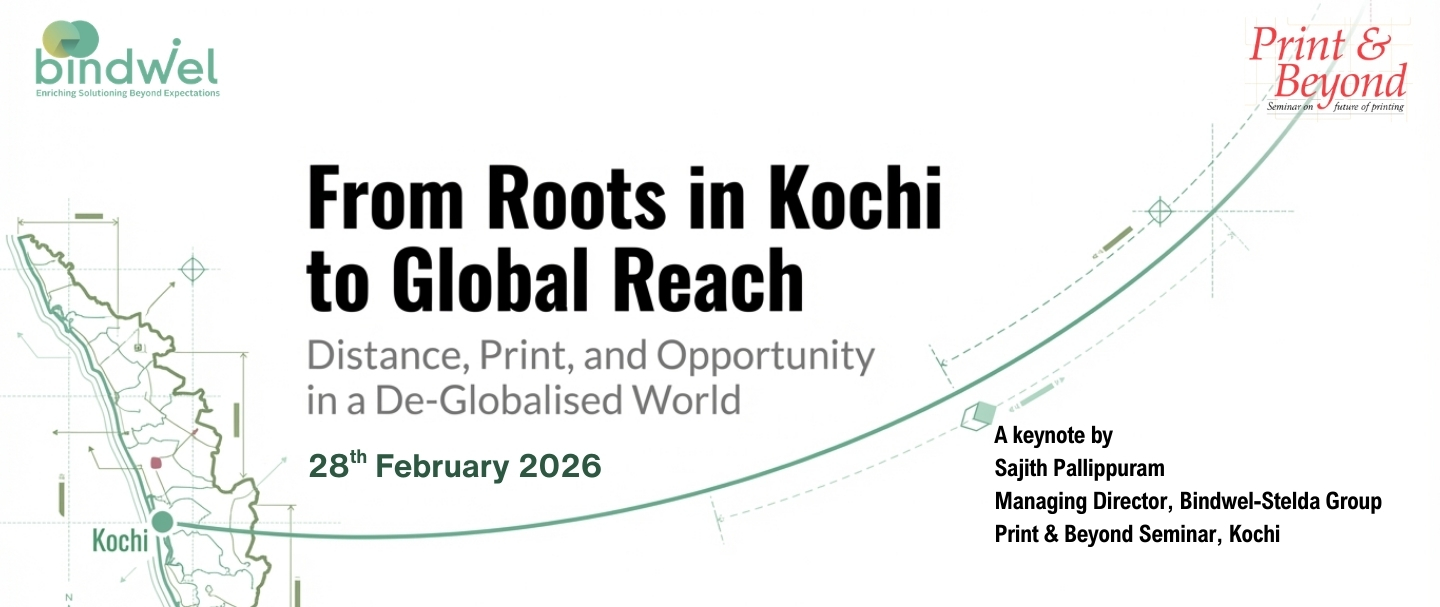
At a recent industry keynote in Kochi, I reflected on how distance has shaped both my personal journey and the evolution of the printing and bookbinding industry. From my early years in Ernakulam to engineering studies in Warangal and professional life in Mumbai, each phase expanded perspective and opportunity.
But in printing, distance is not just personal. It is economic, strategic, and operational.
For companies like Bindwel Technologies, understanding how distance influences manufacturing, logistics, and customer relationships is becoming increasingly important in a de-globalising world.
The Role of Distance in the Print Industry
Printing has always been governed by geography.
Key questions every printer and print manufacturer asks:
- How far can a product travel?
- At what freight cost?
- At what working capital cycle?
- At what margin?
Different print segments behave differently:
- Pharmaceutical packaging and leaflets often travel long distances due to regulatory approvals and compliance standards.
- Books remain one of the few print products that move across continents, especially for educational and religious markets.
- Corrugated packaging, mono cartons, and flexible packaging increasingly operate within shorter geographic radii due to freight economics and supply chain proximity.
- Digital printing enables hyper-local production for short runs, regional publishing, and SME requirements.
The economics of distance are shifting.
De-Globalisation and the Changing Print Landscape
Global supply chains are being reassessed. Risk mitigation is increasingly prioritised over pure cost optimisation.
This has implications for print manufacturing in India:
- Supply chains are shortening.
- Brands are seeking faster turnaround.
- Educational publishing is seeing renewed interest in physical books.
- Digital print technology is enabling decentralised production.
In this environment, one insight becomes clear:
Files travel globally. Print fulfils locally.
As digital workflows accelerate, physical print production increasingly favours intelligent proximity to the end market.
From Machines to Capability: The Next Phase of Print Growth
For decades, growth in the printing and bookbinding machinery sector was driven by capital investment in land, infrastructure, and high-speed equipment. That phase built scale and capability across India.
However, the next phase of competitive advantage may depend on:
- Application knowledge
- Skilled manpower
- In-house R&D and testing labs
- Prototyping capability
- Customer education and early engagement
Customers today face complexity in substrates, specifications, and sustainability requirements. Many struggle not with volume, but with decision-making risk.
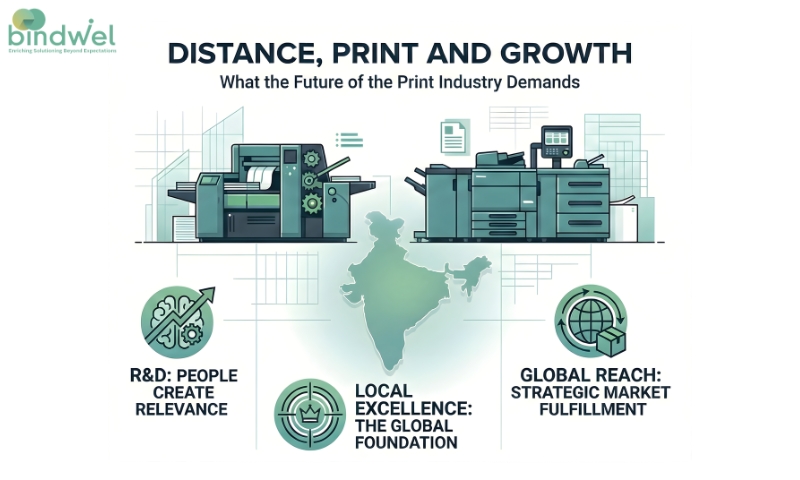
Machines create capacity.
People create relevance.
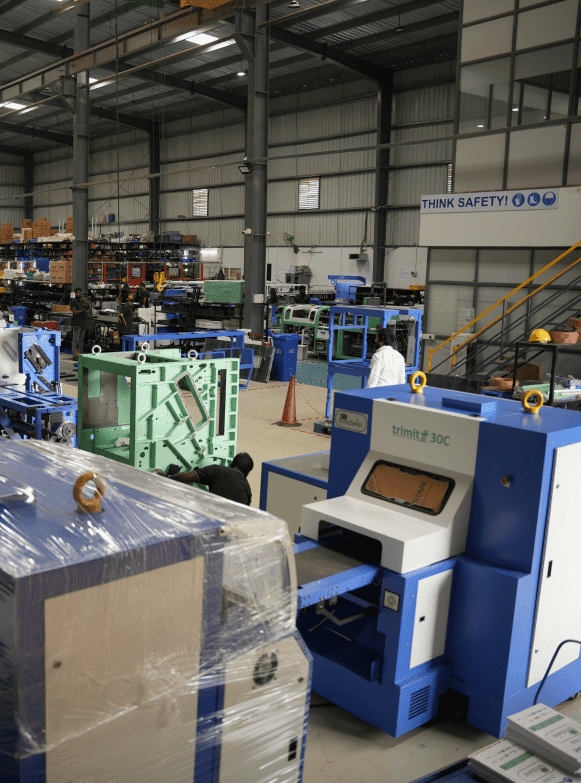
At Bindwel Technologies, this philosophy guides our approach to bookbinding machinery manufacturing and print solutions. Investing in people, R&D, and continuous learning reduces the distance between customer need and technical solution.
India’s Opportunity in Global Print Manufacturing
India has strong capabilities in book printing, educational publishing, and packaging production. However, export growth in finished print products remains limited compared to intermediate goods.
If India increases its share of finished product exports – from textbooks to high-complexity bound books and printed components – the entire print value chain stands to benefit.
Success in export markets increasingly depends on complexity management: substrates, finishing operations, binding quality, and consistent execution.
The opportunity lies not only in scale, but in sophistication.
Why Local Excellence Matters in a Global Market
One of the most important lessons from both life and business is this: global relevance begins with local excellence.
Companies that build strong foundations in their immediate markets – through consistent quality, reliable service, and technical depth – create credibility that travels.
For print technology companies in India, the focus must remain on:
- Engineering excellence
- Reliable after-sales support
- Continuous innovation
- Understanding customer application environments
When foundations are strong, partnerships follow – not because of distance travelled, but because of value delivered.
Choosing Distance Strategically
As the printing industry evolves in response to digital transformation, supply chain shifts, and changing consumption patterns, leaders must rethink traditional growth assumptions.
The real question is no longer “How far can we expand?” but:
Where are we most relevant?
Distance will continue to matter – but it must be chosen strategically.
For the print and bookbinding industry, the future will belong not necessarily to the largest plants, but to those who combine engineering strength, human capability, and intelligent proximity to market demand.
When roots are strong, reach becomes sustainable.