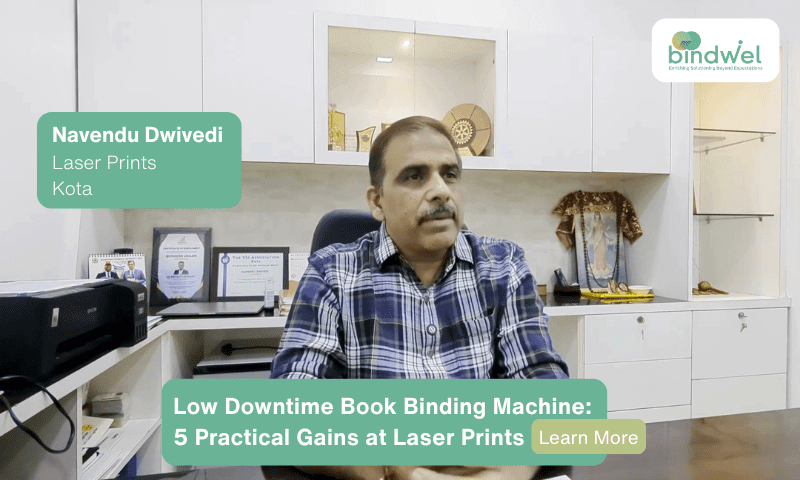
When a printer says downtime matters more than peak speed, it is worth listening. At Bindwel, we recently spoke with Navendu Dwivedi, owner of Laser Prints, Kota, about his experience with the BW@2500 V24. His feedback highlights what a Low Downtime Book Binding Machine actually means in day-to-day production.
About Laser Prints, Kota
Laser Prints operates in the books segment, alongside full commercial printing. However, book printing remains their core business focus.
Before installing the BW@2500 V24, they were running another six-clamp machine from a different manufacturer. According to Navendu, the machine was “more or less okay.” But when they compared it with Bindwel’s offering, the differences became clear.
Speed Is Important — But Downtime Is Costlier
Navendu explained something many printers quietly acknowledge:
Speed alone is not the deciding factor.
What matters is whether the machine runs when required.
He shared that earlier they faced service-related delays. Engineers were located far away. Spare parts often took 7–8 days to arrive. If a small component failed, production had to wait.
In a book printing setup, that waiting time creates stress across departments.
With the BW@2500 V24, what stood out for Laser Prints was reliability. The trust factor increased because support was accessible and downtime reduced significantly.
That is where a Low Downtime Book Binding Machine proves its worth — not in catalog specifications, but in uninterrupted production.
Consistent Milling and Glue Penetration
Another key observation from Laser Prints was about milling quality and glue application.
Navendu noted:
- Milling is proper and uniform
- Glue penetration is consistent
- Application is not uneven
He mentioned that with their previous setup, glue sometimes flowed heavier at the top and reduced toward the bottom of the spine. This unevenness led to variability in quality.
With the BW@2500 V24:
- Glue spread is even
- Adhesive penetration is stable
- Consumption is controlled
He specifically mentioned that adhesive consumption reduced because application became uniform.
From our engineering standpoint, this aligns with the three-roller spine gluing system and driven side gluing mechanism of the BW@2500 V24. When glue distribution is controlled mechanically, waste reduces naturally.
A Low Downtime Book Binding Machine is not only about uptime — it is also about controlled, repeatable output.
Installation Discipline Matters
One aspect that surprised Laser Prints was the installation process.
Navendu pointed out that Bindwel’s team was strict about:
- Proper floor leveling
- Adequate space allocation
- Electrical requirements
- Earthing
- Stabilizer setup
The installation took two days. According to him, what might appear “normal” was handled with detailed attention.
From our side, installation discipline prevents future bottlenecks. Improper grounding, unstable power, or uneven flooring directly impact performance and reliability.
Many production issues begin at installation. Addressing them upfront reduces future downtime — reinforcing the concept of a Low Downtime Book Binding Machine.
Spine Squaring: An Overlooked Quality Marker
Navendu highlighted something often ignored — spine squaring.
He said:
When a book is bound, the spine squaring should be proper. In this machine, it forms correctly. Many machines do not achieve that properly.
Spine geometry directly affects:
- Book stackability
- Shelf presentation
- Perceived quality
For printers delivering to publishers, this detail matters.
Proper milling, controlled glue penetration, and accurate cover nipping all contribute to this outcome. When these systems work in coordination, spine formation improves.
Again, reliability in finishing is what defines a Low Downtime Book Binding Machine in practical terms.
Service Responsiveness Builds Trust
Navendu clearly emphasized trust.
He stated that with Bindwel:
- Support response is faster
- Downtime is minimal
- Spare availability is dependable
For a printer handling fluctuating book volumes in short windows, waiting a week for parts is not viable.
Reliability is not just mechanical. It includes service infrastructure.
A Practical Recommendation from Experience
Navendu shared that when production volumes increase within a short span of time, the machine must perform without hesitation.
From his experience, uptime, consistent binding quality, and dependable support made the difference.
He mentioned that printers with strong volume requirements should consider this category of machine because:
- Running time is good
- Print-to-bind quality consistency is strong
- Production confidence increases
For printers evaluating equipment, the question is not only how fast it runs — but how reliably it runs every day.
That is where a Low Downtime Book Binding Machine demonstrates measurable value.
👉 Follow Bindwel on Facebook, LinkedIn, Twitter, Instagram and YouTube for stories from behind the book and updates from the festival. Be part of the journey that keeps reading alive.